The Ultimate Guide to Volume Hair for Fine and Thin Strands
The Unique Challenge of Fine Hair
Fine hair is one of the most common hair concerns worldwide, and yet it remains one of the most persistently misunderstood. Many people confuse fine hair with low hair density, but the two are distinct — fine hair refers to the diameter of individual strands, not the number of hairs on the scalp. However, when a person has both fine individual strands and relatively low overall density, the combination results in hair that lies completely flat, fails to hold texture or body for more than a few hours, and visually appears significantly thinner than it actually is. For women in this situation, achieving volume hair that lasts all day and looks natural rather than artificial has historically been an enormous challenge. Modern hair extension technology, designed specifically with fine hair needs in mind, has fundamentally changed what is possible — delivering real, lasting, undetectable volume without the stress or damage that older methods imposed on delicate strands.
Lightweight Extensions Designed for Delicate Hair
The most important factor when selecting extensions for fine hair is weight — specifically, ensuring that the extension installation does not impose excessive tension on individual natural strands that are already narrower and more vulnerable than average. Tape-in extensions are widely regarded as the safest and most effective semi-permanent option for fine hair because their thin adhesive panels distribute weight across a wide area rather than concentrating it at a single point. Nano ring extensions, which use tiny micro-rings instead of heat or adhesive, are another excellent choice for fine hair, as the rings can be precisely sized to hold without gripping individual strands too tightly. Seamless clip-in extensions — which use a silicone or PU base rather than a traditional fabric weft — are the preferred at-home option because their ultra-thin profile does not create visible ridges through fine hair, and they can be removed each evening, giving delicate strands the nightly rest they need.
The Role of Colour in Creating Perceived Volume
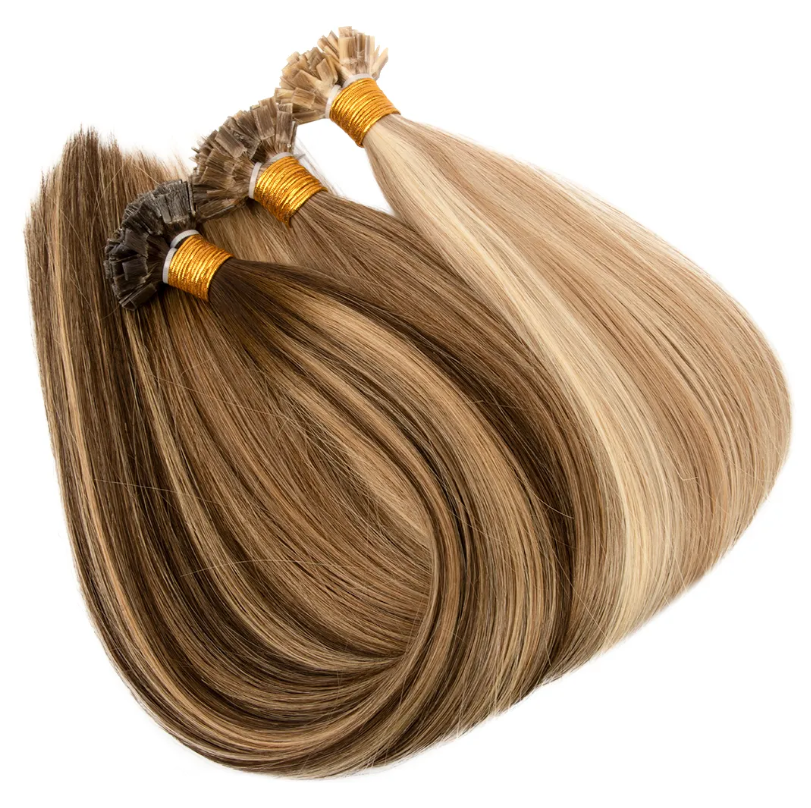
Colour strategy is an often-overlooked but genuinely powerful tool in the pursuit of visually thicker hair. Single-tone, flat colour on fine hair emphasises its lack of dimension, making it look even thinner than it is. Multi-tonal extensions — those with natural highlights, lowlights, or a subtle balayage effect blended through them — create the illusion of depth, movement, and density that single-colour options simply cannot match. When fine hair is combined with multi-tonal extensions that include shades slightly lighter than the natural base colour, the resulting visual contrast between strands creates the impression of significantly more volume from every angle. Choosing extensions with a tonal variation of two to three shades around your natural colour, rather than a single exact match, will dramatically enhance the perceived fullness of the finished style and create a far more convincing, three-dimensional result.
Daily Habits That Preserve Volume in Fine Hair
Even the best volume hair extensions will underperform if the daily habits surrounding them work against their effectiveness. The most important daily practice is protecting the root area from moisture and weight-inducing products. Heavy conditioners, creamy styling products, and oils applied at or near the root flatten fine hair almost instantly and can cause tape-in bonds to slip. Instead, focus all moisturising and conditioning products on mid-lengths and ends where they add shine and manageability without affecting root lift. A volumising dry shampoo is an excellent daily ally — it absorbs oils at the root, adds texture, and can significantly refresh both the natural hair and extension volume between washes. Sleep on a silk pillowcase to reduce friction-induced flattening overnight, and loosely braid or twist hair into a low ponytail at bedtime to maintain movement and prevent tangling of extensions while sleeping.
When to Consult a Professional for Fine Hair Extensions
While at-home clip-in extensions are perfectly manageable for any beginner, anyone considering semi-permanent volume extensions for fine hair should strongly consider at least an initial consultation with a certified extension specialist. The reason is simple — fine hair has a lower tolerance for poor installation technique than average hair, and an incorrectly applied set of tape-in or bonded extensions can cause traction alopecia, breakage, or damage that takes months to recover from. A good extension specialist will assess your natural hair's strength and density, recommend the appropriate gram weight and extension method, and install the first set in a way that maximises volume while distributing weight so safely that individual strands experience no stress at all. Think of the consultation not as an optional luxury but as the investment that protects your natural hair and ensures your extension experience is entirely positive from the very first day.